I’ve noticed a disturbing cookie trend in the past few years.
For me it started with Metropolitan Market’s The Cookie. Don’t get me wrong, I loooooove Met Market. Grocery-wise, they have all the best stuff. It’s one of the few places I can find “the good almond paste” for my baking. And have you ever tried their fresh-squeezed tangerine juice? Soooo delicious. So, while I hate to disparage my beloved Met Market, I just can’t with their product, The Cookie. You know what I’m talking about. That giant hunk of raw dough sitting out on a warming tray. I mean, what is going on there? Is the idea that the warming tray is going to bake it through, because I can assure you… it’s not. And don’t even think about putting that cookie in bag. (As an aside, there is an acceptable The Cookie, the mini ones that come pre-packaged are actually baked and worth eating. Get those. The Cookie is a good cookie, when it’s not a big, raw, mush ball).
Thankfully, Seattle doesn’t have an outpost of the controversial Crumbl Cookie, but if we did, you know what side of that debate I’d be on.
So, at the risk of becoming the Lisa From Temecula of cookies, I’ll come out and say it: “Bake my cookie!”
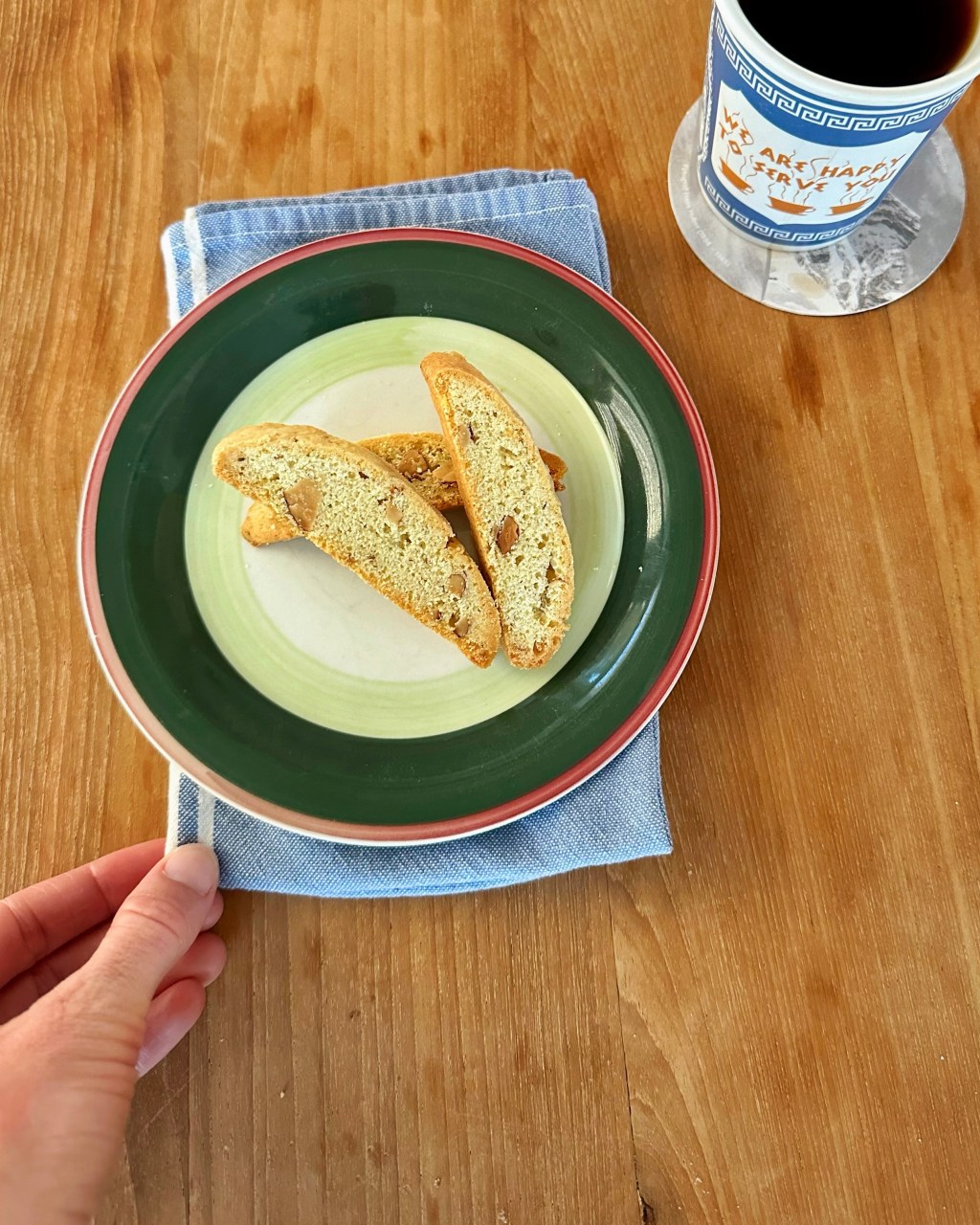
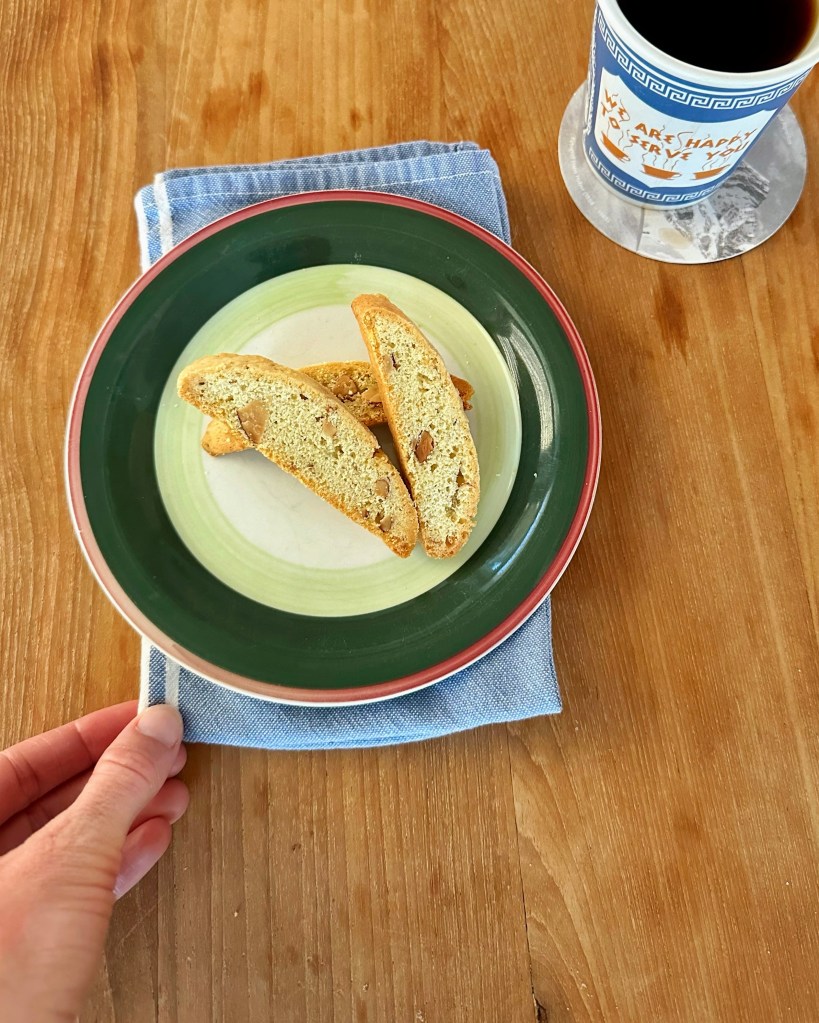
I’ve always been a fan of the little dry cookie. I love dunking a crumbly little buddy in my coffee. And no one does the little dry cookie better than the Italians.
Does anyone in Seattle remember the original La Panzanella bakery at 14th and Union? It was a bona fide Italian bakery. The head baker there, was a guy named Ciro. Ciro would take interested laypeople, like members of my family, behind the scenes and show them his bread baking process and the big deck ovens. Now we have fancy artisan bakeries all over Seattle, but Ciro was one of the first, a rarity for his time. La Panzanella used to have these little hard dry lemon cookies that were not exactly the kind of cookie most kids go for, but I loved them. I will have to teach myself to make those. In the meantime though, I have Aunt Victoria’s biscotti. My sweet reprieve from the under-baking madness.
The recipe my family has always used is from the original Chez Panisse Desserts by Lindsey Shere. My mom owns our copy of the book, the first edition, published in 1985.
The book is a time capsule.
These days, even the more technical cookbooks are entrenched with storytelling. Backstories to the recipes, from anecdotes about working in restaurant kitchens, to the author’s partner’s favorite meals, to stories of food made in far-flung locales. The capital-S Story these days is so ubiquitous (I mean, what is this blog, but a string of stories held together by a recipe or two?) it’s unremarkable, until you read an old cookbook that bears simply a sentence, if that, of explanation about each recipe.
The original Chez Panisse Desserts cookbook is shockingly this way. With each chapter intro, and even Alice Waters’ preface, reading almost like a textbook, with stark descriptions of techniques and lists of ingredients. A read, with fresh eyes, feels like that scene in Best in Show where Harlan Pepper (Christopher Guest) recounts how he “used to be able to name every nut… that there was.”
I don’t say this to disparage the cookbook at all, but simply to notice how our expectations of the content we consume changes over time, and thus, so do writing styles. I’d be really curious to know if the preface and chapter intros have changed in later editions. If anyone out there has one, let me know!
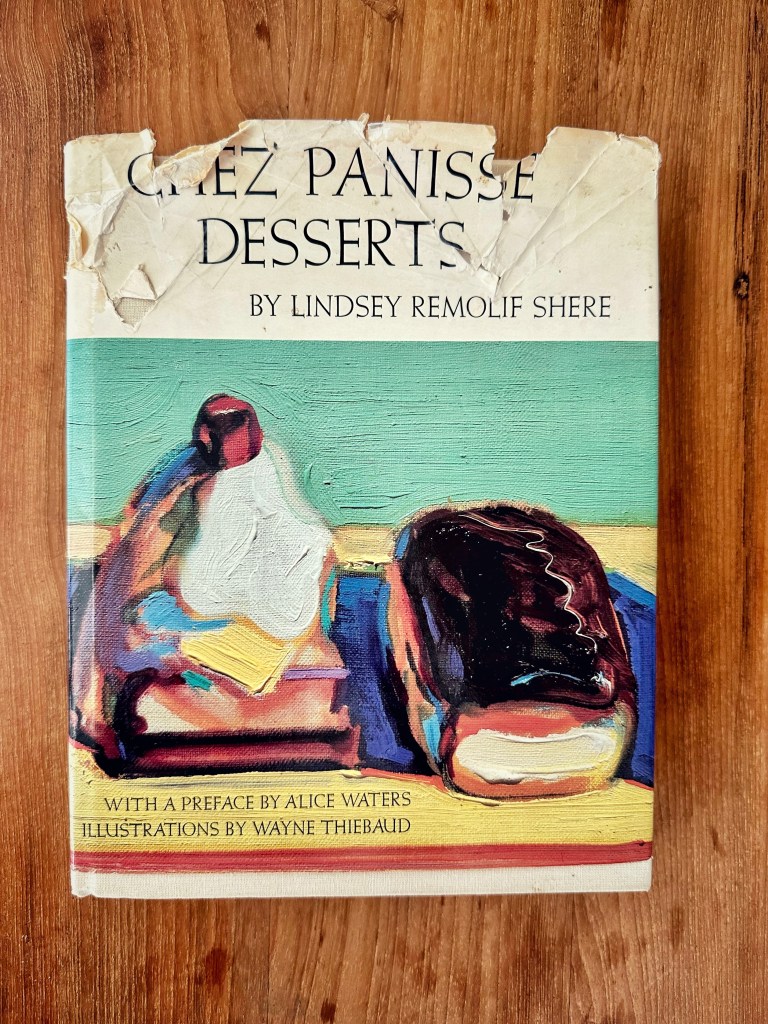
Oh, and there are no photos of the food! Not a one. However, the cover is a gorgeous Wayne Thiebaud painting and the book includes delightful illustrations by Thiedbaud throughout. He is an artist close to my heart as he was a professor at my alma mater, UC Davis, and much of his subject matter was pastry-related.
The recipe in the book that contains the closest thing to a personal anecdote is Aunt Victoria’s Biscotti. Shere grants us but one sentence: “My 85-year old Italian aunt Victoria still makes these for all the realtives; everyone brings back a couple of coffee cans full from visits to Seattle.” All I have to say, is “more of this, Lindsey!!”
And what a perfect biscotti Aunt Victoria’s it is. Perfectly dry, yet still tender. The version in the book contains almonds, grappa, anise seed, and anise extract, which is delicious. But, subtracting those ingredients, the base recipe is ripe for variation. At the risk of sounding like Harlan Pepper, any nut could be substituted, or even dried fruit or mini chocolate chips. Vanilla, almond extract or citrus zest can be swapped for the anise extract. Any liqueur or brandy for grappa. Even the base can be adjusted, a tablespoon or two of cocoa powder swapped for flour. My mom’s variation is: hazelnuts for almonds, frangelico for grappa, and orange zest for anise.
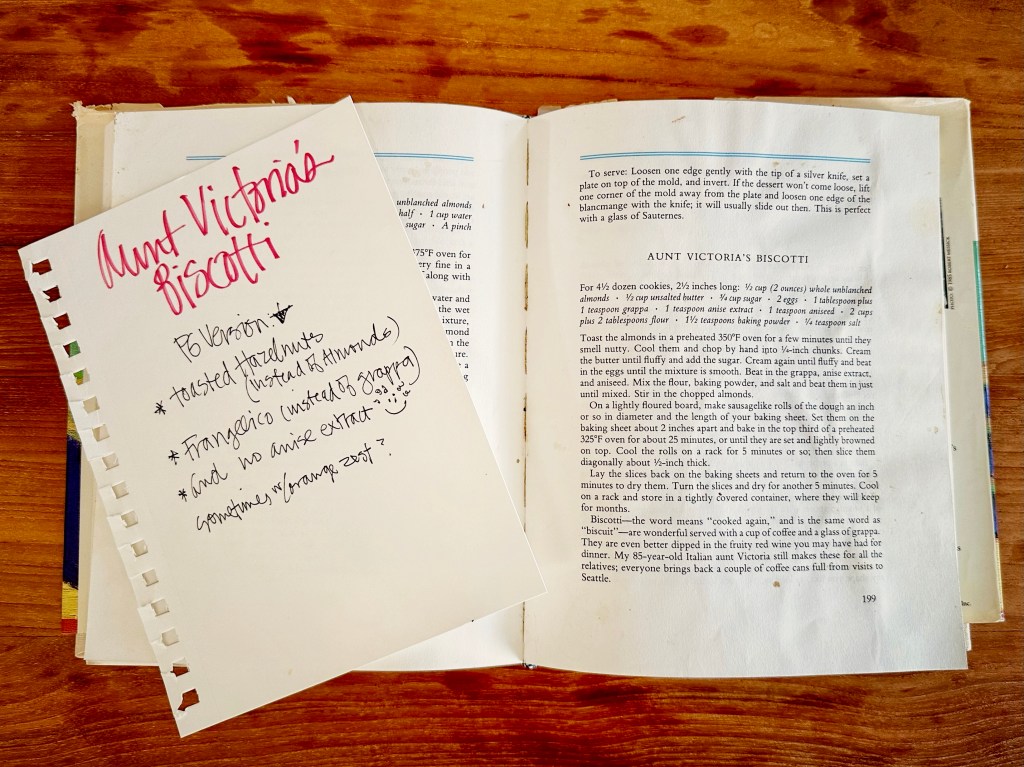
Here are my variations:
- In my opinion, anise seed has a more delicate flavor than anise extract. So, in order to bring that nuanced flavor forward, I toast the anise seeds and reduce the extract to 1/2t (from 1t).
- I didn’t have grappa, so I used amaretto, because amaretto is becoming a thing for me now, and the flavor complements the almonds in the biscotti. I also reduced the amount to 1T (from 1T + 1t). I found the original recipe for the dough to be slightly sticky, so reducing the liquid (the liqueur and the extract) helped with that.
- Shere claims the yield is 4 1/2 dozen, I got 4 dozen, but yield will really depends on how big one likes their biscotti.
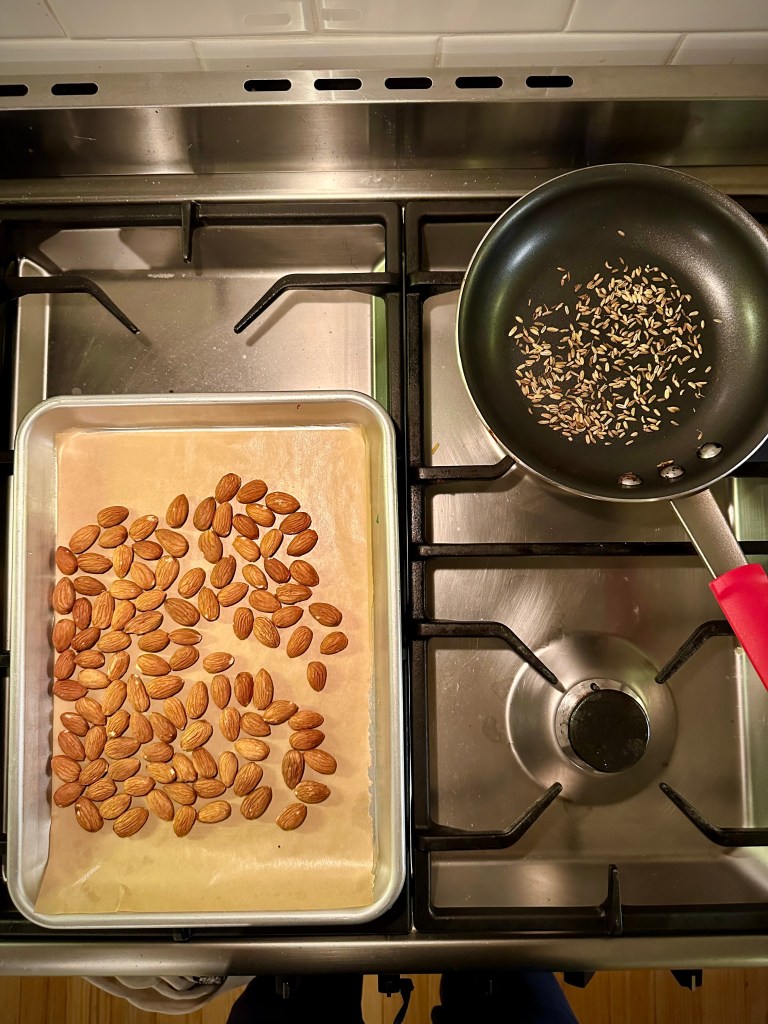
So, here is my version of Aunt Victoria’s biscotti. Have these with a cup of strong coffee and experience the joy of The Little Dry Cookie.
Aunt Victoria’s Biscotti (more or less)
Adapted from Chez Panisse Desserts by Lindsey Remolif Shere
Yield: About 4 dozen
Time: About an hour and a half
Ingredients:
| 1/2c (2oz, 60g) whole, unblanched almonds |
| 1t anise seed |
| 1/2c (1 stick, 113g) unsalted butter, at room temperature |
| 3/4c (5.3oz, 150g) sugar |
| 2 eggs |
| 1T (1/2 oz, 15mL) amaretto |
| 1/2 t anise extract |
| 2c +2T (9.4oz, 266g) all purpose flour |
| 1 1/2t baking powder |
| 1/4 t kosher salt |
- Toast the almonds in a pre-heated 350F oven until they smell nutty (about 10min). Turn oven down to 325F.
- Cool and chop almonds into 1/4in chunks.
- Toast the anise seed in a small frying pan until fragrant (about 3min).
- In the bowl of a stand mixer, cream the butter and sugar until fluffy.
- Beat in the eggs until the mixture is smooth.
- Beat in the amaretto, anise extract, and anise seed.
- In a separate bowl, whisk the flour, baking powder, and salt.
- Beat the dry ingredients into the butter mixture until just mixed.
- Stir in the chopped almonds.
- On a lightly floured surface, make sausagelike rolls of the dough an inch or so in diameter, the length of a baking sheet.
- Set them on the baking sheet about 2in apart.
- Bake in the preheated 325F oven for about 25min, or until they are lightly browned on top.
- Cool on a rack for at least 5min, up to overnight.
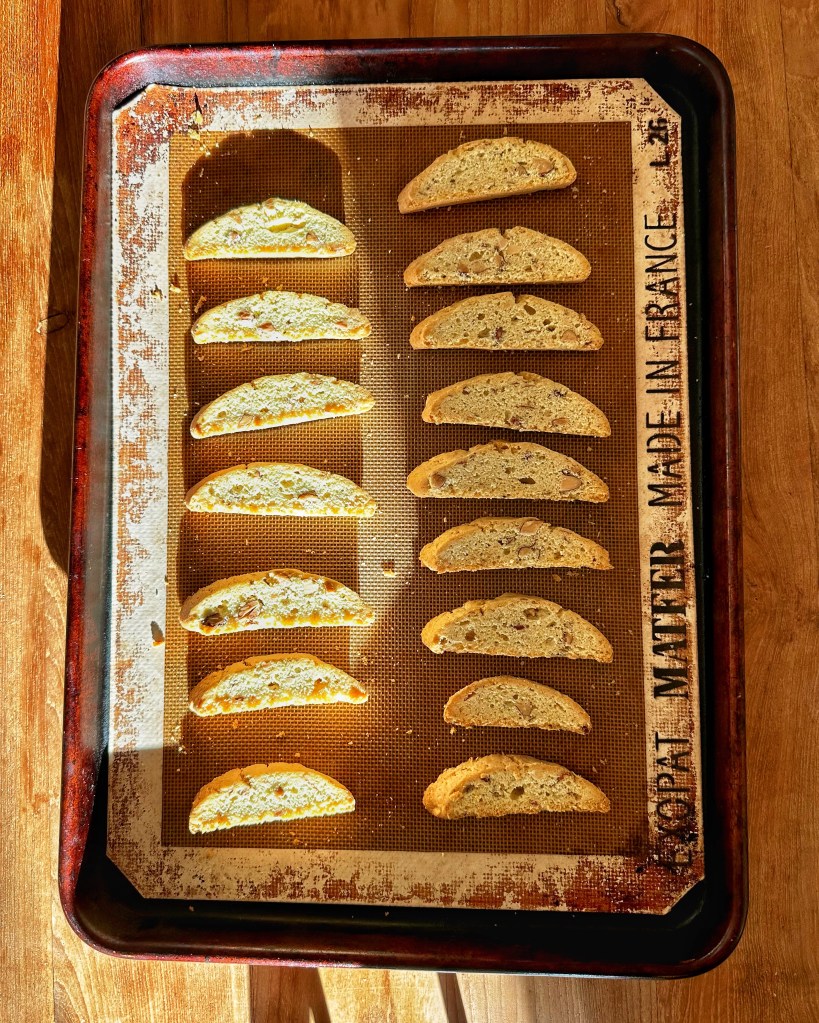
- Slice the rolls diagonally about 1/2in thick.
- Lay the slices back on the baking sheets and return to the oven for 5min to dry them.
- Turn the slices and dry in the oven for another 5min.
- Cool on a rack
Store biscotti in an airtight container. They will keep forever, but I promise you won’t have them around long enough to find out.

 Tremonte's Italian American